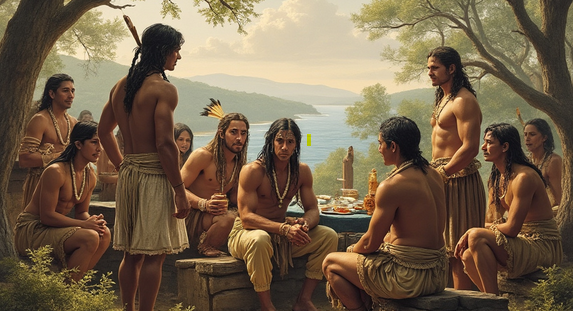
WEST VIRGINIA - While West Virginia is often celebrated for its rugged mountain beauty and coal-mining heritage, its history begins thousands of years before the first European settlers arrived. The story of the Mountain State’s first inhabitants is a complex tapestry of migration, trade, and resilience.
Contrary to longstanding myths that the region was merely a "hunting ground," West Virginia was home to diverse cultures that built permanent settlements and sophisticated societies.
Ancient Ancestors: The Mound Builders
Long before modern tribal names emerged, the region was dominated by the Adena and Hopewell cultures (roughly 1000 BCE to 1000 CE).
These people are known as "Mound Builders" because of the massive earthworks they left behind. These structures served as burial sites, ceremonial centers, and astronomical markers.
- The Grave Creek Mound: Located in Moundsville, this is one of the largest conical burial mounds in the United States, standing roughly 62 feet tall.
- The Kanawha Valley: This area was once a dense hub of indigenous activity, featuring numerous earthworks that suggest a highly organized social structure.
The Major Tribes of the Historic Era
By the time of European contact in the 1600s and 1700s, several distinct nations claimed, inhabited, or utilized the lands of West Virginia.
The Shawnee were perhaps the most prominent group in the region during the 18th century. Known as "Southerners," they moved frequently due to pressures from both European settlers and the Iroquois. They established significant towns along the Ohio and Kanawha Rivers, such as Lower Shawneetown.
The Cherokee, while primarily centered in the Carolinas and Georgia, claimed much of southern West Virginia. They used the Appalachian ridges for hunting and as a buffer zone between themselves and northern rivals.
The Moneton and Monacan The Moneton people lived in the Kanawha Valley. Though less is known about them compared to the Shawnee, early explorers recorded their presence in permanent villages, where they farmed corn and traded extensively.
The Haudenosaunee (Iroquois Confederacy). The Iroquois, particularly the Seneca, did not always live permanently in West Virginia, but they exerted immense political and military control over it. Through the Beaver Wars of the 17th century, they pushed other tribes out to dominate the fur trade, turning the region into a highly contested territory.
Life in the Mountains
The indigenous peoples of West Virginia were not just nomadic hunters; they were skilled engineers and farmers.
- Agriculture: They cultivated the "Three Sisters"—corn, beans, and squash—which provided a sustainable and balanced diet.
- The Warrior’s Path: A famous trail (the Seneca Trail or Great Indian Warpath) ran north-to-south through the state. Much of modern U.S. Route 219 follows these ancient indigenous footpaths.
- Salt Production: Long before the Kanawha Salines became a 19th-century industry, Native peoples were extracting salt from the springs at Malden for preservation and trade.
The Impact of Expansion
The 1700s brought a series of violent conflicts as Virginia colonists pushed westward. Significant battles, such as the Battle of Point Pleasant in 1774, marked the beginning of the end for sovereign indigenous control in the area.
Under the pressure of treaties—many of which were signed under duress—most Native groups were forced to migrate further west into Ohio, Indiana, and eventually Oklahoma.
A Living Heritage: While there are no federally recognized tribes headquartered in West Virginia today, the descendants of these nations remain. Many West Virginians carry indigenous ancestry, and the state’s geography is a permanent monument to its first people—from the name of the Kanawha River to the Allegheny Mountains.