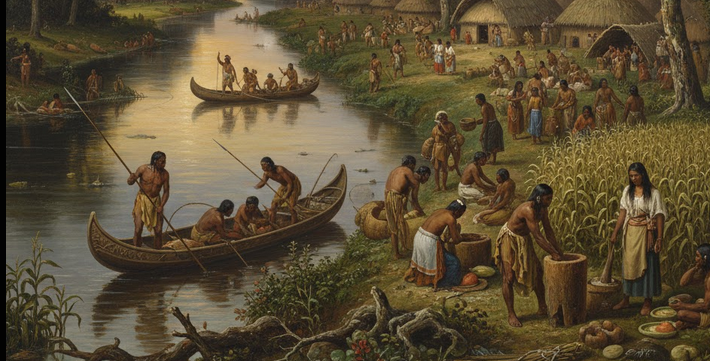
VIRGINIA - While Virginia is commonly known as the "Old Dominion," its history dates back thousands of years, with a vast network of sophisticated chiefdoms and diverse linguistic groups. Long before the 1607 arrival of the English at Jamestown, Virginia was a densely populated land of farmers, hunters, and skilled diplomats.
The Three Great Linguistic Groups
At the time of European contact, the peoples of Virginia were divided into three major language families. This linguistic diversity reflected a complex political landscape in which different nations coexisted through trade, marriage, and, occasionally, conflict.
- The Algonquians (The Coastal Plain). The most famous group in Virginia, the Algonquians, occupied the Tidewater region. They were united under the Powhatan Paramount Chiefdom. Led by Wahunsenacawh (the father of Pocahontas), this powerful alliance comprised more than 30 tribes, including the Pamunkey and Mattaponi. They lived in settled villages with longhouses and relied heavily on the resources of the Chesapeake Bay and its rivers.
- The Siouans (The Piedmont) In the central rolling hills between the fall line and the Blue Ridge Mountains lived the Siouan-speaking peoples, such as the Monacan and Mannahoac. Unlike the centralized Powhatan, these groups lived in autonomous villages. They were known for their copper trade and for constructing earthen burial mounds, some of which remain visible in the Shenandoah Valley.
- The Iroquoians (The Southern and Western Regions) To the south and west were Iroquoian speakers, including the Nottoway, Meherrin, and the Cherokee. In the far southwestern corner of the state, the Cherokee used the rugged terrain for hunting and established settlements that connected Virginia to the broader Appalachian culture.
Architecture and Agriculture
Virginia's indigenous people were master land managers who shaped the environment to suit their needs.
- Yehakins: These were the traditional houses of the Tidewater Algonquians, made of bent saplings covered with woven mats or bark. They were cool in the summer and easily insulated in the winter.
- The Three Sisters: Agriculture was the backbone of Virginia tribal life. They grew corn, beans, and squash in large communal fields. This surplus of food allowed for the development of complex social hierarchies and large-scale religious ceremonies.
- Foraging and Hunting: They supplemented their crops with seasonal harvests of nuts, berries, and fish. In the spring, massive runs of shad and sturgeon provided a vital protein source, while winter was the primary season for deer hunting.
The Impact of Jamestown and the Anglo-Powhatan Wars
The arrival of English settlers in 1607 initiated a century of rapid change and intense conflict.
Initially, the Powhatan Chiefdom attempted to incorporate the English into its existing trade system. However, as the colony expanded into tobacco farming, tensions escalated into three major wars (1610–1646). The 1646 treaty effectively ended the sovereignty of the Powhatan Chiefdom, forcing tribes onto small "tributary" lands—the precursors to modern reservations.
Resilience and Recognition
Despite centuries of displacement and the "Paper Genocide" of the early 20th century (where state records attempted to erase indigenous identity by reclassifying individuals as "colored"), Virginia’s Native peoples remained.
Today, Virginia officially recognizes 11 tribes, seven of which have also received federal recognition.
- The Pamunkey and Mattaponi: These tribes maintain two of the oldest reservations in the United States, established by treaties in 1646 and 1677.
- The Monacan Indian Nation, now headquartered in Amherst County, has worked tirelessly to preserve its ancestral burial mounds and cultural history.
A Lasting Legacy: Virginia is blanketed in indigenous names that remind us of its original inhabitants. From the Appomattox and Rappahannock rivers to cities like Roanoke, the language of the first people is woven into the very fabric of the Commonwealth.