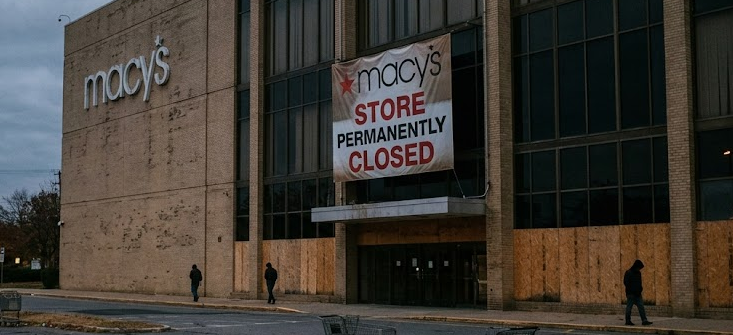
PENNSYLVANIA - For generations, a trip to Macy's wasn't just an errand; it was an event. From the dazzling holiday window displays at the historic Wanamaker Building in Center City Philadelphia to the bustling makeup counters in suburban shopping malls, the department store was a cornerstone of American retail.
 But recently, Pennsylvania shoppers have noticed a quiet, steady retreat. From Exton Square Mall and Altoona's Logan Valley Mall to the massive Pittsburgh Mills in Tarentum and the iconic Center City Philadelphia location, Macy's has been locking its doors for good.
It’s natural to feel a pang of nostalgia—and perhaps a bit of frustration—when a community staple disappears. However, the slow exit of Macy's from the Keystone State isn't an isolated incident. It is the result of a massive, nationwide shift in how we shop, combined with a ruthless corporate survival strategy.
Here is a straightforward look at why the iconic retailer is pulling back in Pennsylvania.
1. The "Bold New Chapter" Strategy
First and foremost, the closures in Pennsylvania are part of a massive, nationwide corporate turnaround plan initiated in early 2024 called "A Bold New Chapter."
Faced with declining sales and fierce competition, Macy's leadership made a difficult calculation: to save the company, they had to shrink it. The retailer announced it would close roughly 150 underperforming stores—about a third of its total footprint—by the end of 2026. The goal is to stop bleeding money on unprofitable locations and funnel those resources into upgrading their 350 most successful "go-forward" stores. Unfortunately for Pennsylvania, several of its older or less-trafficked locations didn't make the cut.
2. The "Dead Mall" Epidemic
If you look at where Macy's is closing in Pennsylvania, a pattern quickly emerges: many are anchored to struggling indoor shopping malls.
As consumer habits shifted over the last decade, indoor malls lost their dominance. As foot traffic plummets, smaller retailers move out, leaving giant anchor stores like Macy's stranded in nearly empty complexes. For example, the Pittsburgh Mills mall in Frazer has seen a mass exodus of major tenants in recent years, leaving the massive, 173,000-square-foot Macy's unsustainable. Once a mall enters a "death spiral," it becomes financially impossible for a department store to stick around.
3. The Burden of Massive Real Estate
Department stores were built for a bygone era when shoppers wanted everything—apparel, furniture, housewares, and cosmetics—under one gigantic roof. Today, maintaining these massive, aging buildings requires staggering overhead costs for heating, cooling, staffing, and maintenance.
This is especially true for urban locations like the historic Center City store in Philadelphia. While architecturally beautiful, maintaining an incredibly large, multi-story historic building requires massive sales volume just to break even—a volume that is increasingly difficult to achieve.
4. Shifting Tastes and the E-Commerce Boom
The reality of modern retail is that we simply don't shop the way we used to. The rise of e-commerce giants like Amazon trained consumers to expect endless variety delivered to their doorsteps.
When consumers do shop in person, the middle-class department store is being squeezed from both sides. Budget-conscious shoppers are flocking to off-price retailers like T.J. Maxx and Target, while high-end shoppers are leaning into pure luxury. Interestingly, Macy's Inc. is adapting to this by pivoting its investments. While they are closing traditional Macy's stores, they are simultaneously opening smaller-format stores and expanding their higher-end, more profitable brands: Bloomingdale's and the luxury beauty chain Bluemercury.
5. Urban Retail Hurdles
In urban centers, the math for keeping a massive department store open has become exceptionally tight. A combination of factors—including a slow return of downtown office workers post-pandemic and the rise of organized retail theft—has eaten away at already razor-thin profit margins. In Center City Philadelphia, for instance, police records noted hundreds of high-value retail thefts at the Macy's location over the last few years. While theft alone doesn't usually sink a healthy store, when a location is already struggling with low foot traffic and high real estate costs, retail shrink can be the final nail in the coffin.
What This Means for PA Shoppers
The closure of a local Macy's is undeniably a blow to local economies, resulting in lost jobs and empty retail space that is difficult for towns to fill.
However, it doesn't mean the brand is disappearing entirely. Macy's is betting that by shedding its dead weight, the stores that remain in Pennsylvania (and across the country) will be better staffed, better stocked, and more modern.
The era of the sprawling, everything-under-one-roof department store in every suburb is coming to a close. As Macy's turns the page to its "Bold New Chapter," Pennsylvania is simply watching the retail industry reshape itself for the 21st century—one closed door at a time.