PENNSYLVANIA - Today, the Horseshoe Curve in Altoona is a peaceful tourist spot where railfans gather to wave at passing freight trains. But in 1942, this engineering marvel was the "jugular vein" of the American war effort—and the primary target of a secret Nazi sabotage mission that landed on U.S. soil.
This isn't an alternate history novel. It is the true story of Operation Pastorius, the plot to cripple American logistics by severing the rail line connecting Pittsburgh's steel mills to East Coast shipping ports.
The Target: Why the Curve?
To understand why Hitler cared about a curve of track in central Pennsylvania, you have to look at the logistics of World War II.
 The Pennsylvania Railroad (PRR) was the "Standard Railroad of the World," and the Horseshoe Curve was its most critical bottleneck. It was the only way to get heavy freight trains over the steep Allegheny Mountains without using helper engines that would slow down traffic for days.
In 1942, the Curve was moving millions of tons of steel, coal, and troops every month. If the tracks were destroyed, the supply chain for the war in Europe would have paralyzed instantly, forcing trains to take massive detours or rely on slower routes. The German High Command calculated that destroying the Curvy would delay American war shipments by months.
The Invaders: Arrival by U-Boat
In June 1942, a German U-boat (U-202) surfaced off the coast of Amagansett, Long Island, under the cover of fog. Four men paddled ashore in a rubber raft. They were dressed in German naval uniforms (so they wouldn't be shot as spies if caught immediately) but quickly changed into civilian clothes upon reaching the dunes.
The team was led by George John Dasch, a German who had lived in the U.S. for years before the war. With him were explosives, fuses, and over $80,000 in cash (worth over $1.5 million today).
Their mission was specific:
- Travel to Altoona, PA.
- Plant explosives at the Horseshoe Curve.
- Destroy the tracks and, ideally, derail a troop train to maximize the terror.
A second team landed days later in Florida, targeting aluminum plants and bridges, but the Altoona team was the tip of the spear.
The Betrayal: A Crisis of Conscience
The plot fell apart not because of the FBI's detective work, but because of George Dasch.
Almost immediately after landing, Dasch began to lose his nerve. Whether out of fear of failure or a lingering loyalty to his former American life, he decided to defect. He traveled to Washington, D.C., checked into the Mayflower Hotel, and called the FBI.
The agents initially treated him as a prank caller. It wasn't until Dasch walked into FBI headquarters and dumped the $84,000 in cash onto a desk that they took him seriously. He gave up the names and locations of his entire team, as well as the Florida group.
The Aftermath: Execution and Fortification
Within two weeks, all eight saboteurs were in custody. A military tribunal—the first of its kind since the Civil War—was convened.
- The Sentence: Six of the eight men were executed by electric chair in August 1942.
- The Informants: Because of their cooperation, Dasch was sentenced to 30 years in prison, and another conspirator, Ernest Burger, received life. Both were eventually deported to Germany in 1948.
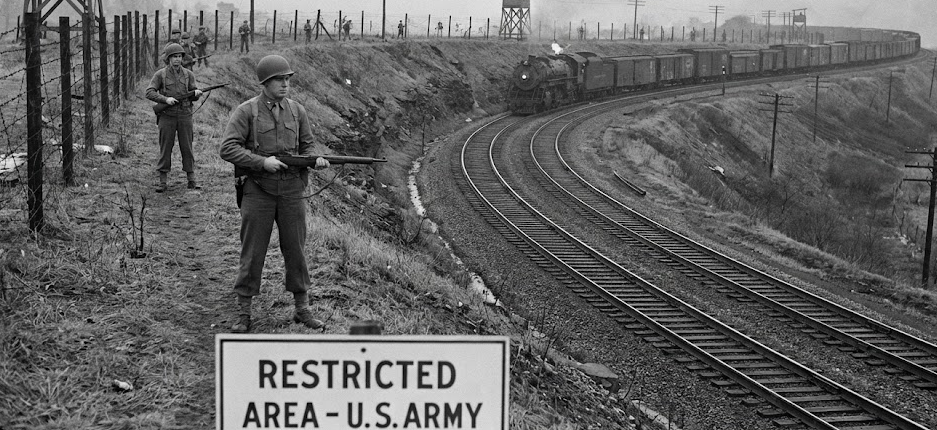
Back in Altoona, the threat changed everything. The Pennsylvania Railroad erected a high wire fence around the entire Horseshoe Curve. For the remainder of the war, the site was closed to the public and patrolled 24 hours a day by armed military guards with orders to shoot on sight.
Visiting Today
You can still visit the CCurvetoday, although the armed guards are gone. A funicular railway takes visitors up to the observation park, where you can watch Norfolk Southern trains grind their way up the mountain.
But next time you stand at the railing, look at the sheer drop-off and the tight geometry of the tracks. It is easy to see why a single box of explosives in 1942 could have changed the course of the war.
Next Steps:
- Visit the Railroaders Memorial Museum: Located in downtown Altoona, this museum holds artifacts from the PRR and details the heavy security that blanketed the city during WWII.
- Read "Sabotage at Horseshoe Curve": If you want the deep dive, local historians have written extensively on the "what if" scenarios of the attack.