DELAWARE - On a quiet stretch of coastline just north of Bethany Beach, the typical beachcomber looks for sea glass or shells. But in Delaware, there is a specific breed of local who waits for the "Perfect Storm." They aren't looking for waves; they are looking for "The Faithful Steward."
This is the story of Coin Beach, where a tragic 1785 shipwreck turned a small patch of sand into a literal treasure chest that keeps on giving, nearly 250 years later.
The Disaster of 1785
In July 1785, a ship called The Faithful Steward set sail from Londonderry, Ireland, bound for Philadelphia. It was a vessel of hope, carrying 249 passengers seeking a new life in the young United States. Crucially, its cargo hold was packed with heavy iron vats containing 400 barrels of British copper halfpennies and gold coins.
Disaster struck just off the coast of Cape Henlopen. The ship ran aground on a sandbar only 100 yards from the shore. In the chaos of the night, the ship broke apart. While 68 people managed to struggle ashore, 181 perished, and the massive weight of the coinage sank directly into the shifting sands of the Delaware coast.
How the "Mushrooms" Form
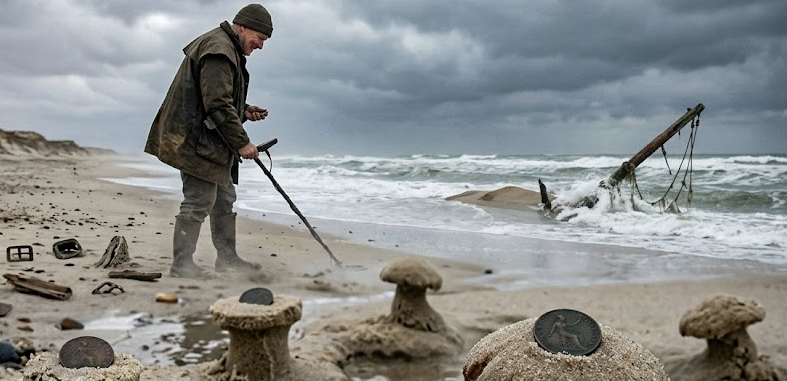
What makes Coin Beach legendary isn't just the history—it's the physics. Because copper and gold are heavy, the coins settled deep into the seabed. However, when a Nor'easter or a hurricane batters the Delaware coast, the churning surf pulls the sand away, exposing the coins.
Locals call the phenomenon "mushrooms." As the tide recedes, a coin sitting on the sand protects the patch directly beneath it from eroding, leaving the coin perched on a tiny pedestal of sand. After a major storm, it is not uncommon to see dozens of these "sand mushrooms" topped with 18th-century copper.
What's Actually Found Today?
While the gold coins are the "holy grail" for metal detectorists, the most common finds are:
- British Halfpennies: Most are worn smooth by the salt and sand, but some still clearly show the profile of King George III.
- Rose Guineas: The rarer gold coins that occasionally surface after massive tidal shifts.
- Artifacts: Shoe buckles, buttons, and pieces of the ship's rigging that survived the centuries underwater.
The Hunter's Code
If you head to the area today, you'll still find people with metal detectors following the high-tide line after a storm. However, there's a catch: while you can keep common coins found on the surface, modern salvage laws and state park regulations are strict about digging or using professional equipment to find larger caches.
The Local Tip: The best time to find a piece of the Faithful Steward isn't during the summer. It's in the dead of winter, right after a punishing Atlantic storm has "cleansed" the beach of its upper layer of sand.
Does the idea of finding a 240-year-old coin under your feet change the way you'll look at the Delaware shoreline this summer?