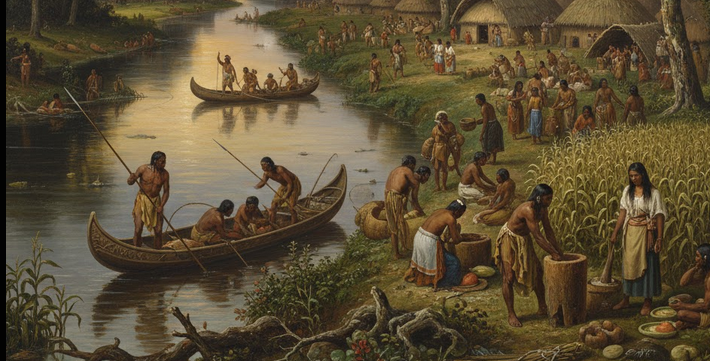
VIRGINIA - While English settlers chose the name "Virginia" to honor Queen Elizabeth I, the land already had a name: Tsenacommacah. This Algonquian word translates to "Densely Inhabited Land," a fitting description for the sophisticated network of over 30 tribal groups that flourished along the coastal plains. Long before the arrival of the Susan Constant, the region was stewarded by the Powhatan (Renape), the Monacan, the Chickahominy, and the Cherokee (Tsalagi).
To these nations, Virginia was Attan-Akamik—the "Great Land"—where the mountains met the sea in a bounty of cedar forests and oyster-rich estuaries.
A Land of Three Worlds
Virginia's geography—the Coastal Plain (Tidewater), the Piedmont, and the Blue Ridge—served as the foundation for three distinct Indigenous cultures:
- The Powhatan Confederacy: Ruling the Tidewater region, this alliance of Algonquian-speaking tribes was led by Wahunsenacawh (Chief Powhatan). They lived in permanent, palisaded villages and viewed the Chesapeake Bay as their primary source of life.
- The Monacan Indian Nation: In the Piedmont region (central Virginia), the Monacan were a Siouan-speaking people known for their copper trade and unique burial mounds. Unlike the coastal tribes, they were hill-dwellers and masters of the Piedmont forests.
- The Cherokee and Shawnee: In the rugged southwestern mountains and the Shenandoah Valley, these nations utilized the high plateaus for hunting and established villages that connected the Appalachian highlands to the Ohio Valley.
Regional and Cultural Designations
Indigenous terminology describes the physical forces that shaped the Virginia landscape:
- The Chesapeake: Derived from Chesepiooc, meaning "Great Shellfish Bay." It was the heart of the Powhatan world, providing a seemingly endless supply of food and a highway for dugout canoes.
- The Potomac: From the word Patawomeck, often interpreted as "The Place Where People Trade." It marked the northern boundary of the Powhatan influence.
- The Shenandoah: While the exact translation is debated, many associate it with an Oneida word meaning "Daughter of the Stars," referring to the way the river reflects the night sky over the valley.
Significant Indigenous Place Names
The map of Virginia is a linguistic tapestry of the Renape and Siouan languages. Roanoke is an Algonquian word for "Shell Money," which was traded throughout the region. The city of Chesapeake carries the name of the bay and the people who lived at its mouth.
Appomattox means "A winding tidal river," and Nansemond translates to "Fishing Point." Occoquan is a Dogue word meaning "At the end of the water." In the west, Wythe and Tazewell counties sit on lands historically significant to the Cherokee. The James River was originally known as the Powhatan River, named after the people and the leader who governed its banks. Even the Blue Ridge Mountains were known as "The High Peaks" or "The Blue Stone Mountains."
A Living Sovereign Presence
Today, Virginia is home to seven federally recognized tribes: the Pamunkey, Chickahominy, Eastern Chickahominy, Upper Mattaponi, Rappahannock, Monacan, and Nansemond. The Pamunkey and Mattaponi have maintained their reservation lands since the 17th century—among the oldest in the United States.
By recognizing the legacy of Tsenacommacah and the "Great Land," we acknowledge a history of sophisticated diplomacy and environmental mastery that continues to thrive from the shores of the Atlantic to the peaks of the Blue Ridge.