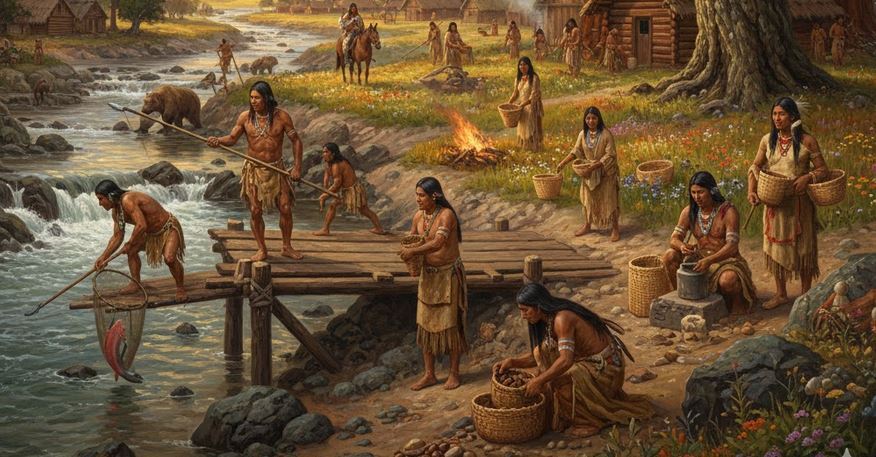
OHIO - Ohio has always been a crossroads. Long before it was the "Buckeye State," the Ohio River Valley was one of the most densely populated and culturally significant regions in North America. To understand how many people lived here before European contact, we have to look at two distinct eras: the age of the great "Mound Builders" and the later historic tribes that met the first explorers.
Estimating the population of pre-contact Ohio is a journey through ancient history and archaeological discovery.
The Era of the Earthworks (1000 BCE – 1650 CE)
Centuries before the "Colonial Conquest," Ohio was home to advanced societies known as the Adena and Hopewell cultures. These groups built massive geometric earthworks and effigy mounds (like the Great Serpent Mound) that suggest a large, organized population.
- Population Density: Archaeologists believe the Ohio River Valley supported a significant population because of its incredibly fertile soil and abundant waterways.
- Estimates: During the Hopewell peak (around 200 CE), some estimates suggest that tens of thousands of people lived in organized communities throughout the southern and central Ohio valleys.
The "Empty" Ohio Mystery (1650 – 1740)
By the time the first Europeans began documenting the region in the late 1600s, they found much of Ohio surprisingly uninhabited. This wasn't because the land couldn't support people, but because of the Beaver Wars.
The Iroquois Confederacy, seeking to control the fur trade, launched a series of devastating raids into the Ohio Country. This forced the original inhabitants—such as the Erie, the Whittlesey, and the Fort Ancient people—to flee or be absorbed. For a period of nearly 80 years, Ohio was largely a "no-man's land" used primarily as a hunting ground.
The Historic Tribes (1740 – 1800)
As Iroquois power waned, various tribes moved (or were pushed) back into the Ohio Country. By the mid-1700s, a new population had established itself:
- The Shawnee: Located primarily in the south and central regions.
- The Miami: Dominant in the western part of the state.
- The Wyandot: Settled in the north near Lake Erie.
- The Delaware (Lenape): Having been pushed out of Pennsylvania and New Jersey, they settled in eastern Ohio.
The Population Numbers
Determining an exact "pre-conquest" number is difficult because of the massive fluctuations caused by the Beaver Wars and early disease.
- Pre-1650 (Early Peak): Some historians estimate the combined population of the Ohio Country was between 40,000 and 60,000 people.
- Mid-1700s (Re-settlement): By the time of the French and Indian War, the population of the various "refugee" tribes in Ohio was likely around 15,000 to 20,000.
While these numbers may seem small compared to modern cities, they represented a high density for a society reliant on a mix of sophisticated agriculture (corn, beans, and squash) and seasonal hunting.