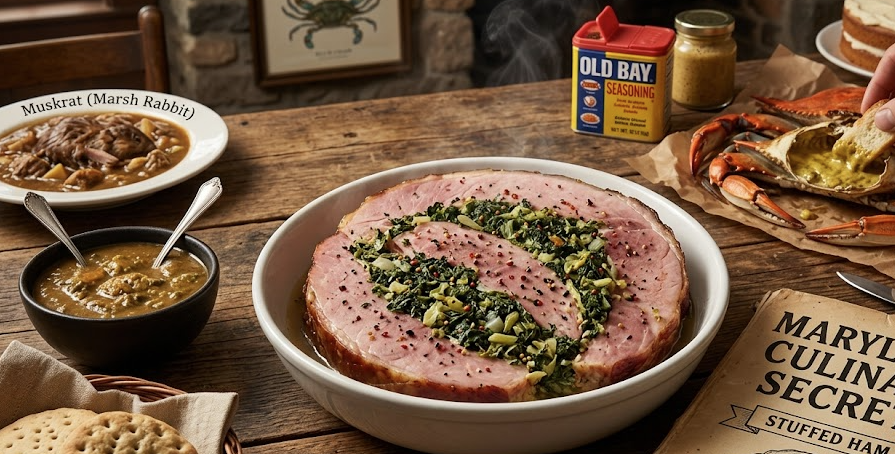
MARYLAND STATE - Maryland is a land of pleasant living, but for the uninitiated, its culinary landscape can feel like a gauntlet. While out-of-staters are usually happy to dive into a pile of steamed crabs, there are corners of the Free State menu that provoke genuine confusion—and occasionally, mild terror.
From swamp-dwelling rodents to "mustard" that isn't a condiment, here are seven Maryland delicacies that separate the locals from the tourists.
1. Muskrat (The "Marsh Rabbit")
Mainly found on the Eastern Shore, particularly in Dorchester County, muskrat is a tradition that dates back centuries. Locals will tell you it tastes like "earthy" duck, but to an outsider, it looks exactly like what it is: a marsh-dwelling rodent. It is often served stewed or fried in butter. If you're feeling brave, you can attend the National Outdoor Show in Cambridge to watch muskrat-skinning competitions before grabbing a muskrat taco.
2. Southern Maryland Stuffed Ham
This isn't your average honey-glazed holiday ham. Stuffed ham is a St. Mary's County staple that involves stuffing a corned (brined) ham with a massive amount of highly seasoned greens—usually kale, cabbage, and onions. The ham is literally sliced open with deep gashes, packed with the spicy vegetable mixture, and boiled in a cheesecloth or a t-shirt. The result is a cold, salty, and incredibly pungent slice of meat that looks like it's "veined" with green.
3. Crab "Mustard."
When an out-of-stater cracks open a blue crab and sees a pool of yellowish, goopy liquid, their first instinct is often to reach for a napkin to "clean" it. Marylanders, however, reach for a piece of bread to dip in it. This is the hepatopancreas, colloquially known as "mustard." It's rich, buttery, and considered the most flavorful part of the crab, but explaining that it's essentially the crab's liver and pancreas usually doesn't help win over the squeamish.
4. Terrapin Soup
The Diamondback Terrapin is the state reptile and the University of Maryland's beloved mascot, but for a long time, it was also a main course. Terrapin soup was once a "high-society" dish served at presidential inaugurations. Today, because the turtles are protected, you'll rarely find the real deal. However, the idea of eating "Testudo" is still enough to make modern visitors (and many PETA-friendly locals) recoil in horror.
5. Beaten Biscuits
A true relic of the Chesapeake, beaten biscuits are nothing like the fluffy, buttery clouds you find at brunch. These are hard, dense, and historically made by beating dough with an axe or a hammer for 30 minutes to an hour to develop air bubbles. They are a more edible version of hardtack. Outsiders often bite into one expecting a soft roll, only to be met with a texture that requires a serious dental plan.
6. Old Bay on Everything
To a Marylander, Old Bay is a lifestyle. To an outsider, seeing it on ice cream, donuts, caramel corn, and even beer feels like a cult-like obsession gone wrong. While the spice blend (a mix of celery salt, red pepper, and "secret" spices) is delicious on seafood, the sight of a Marylander shaking a yellow tin over a perfectly good slice of watermelon is often enough to make visitors question our collective sanity.
7. The 10-Layer Smith Island Cake
While "terrifying" might be a stretch for a dessert, the sheer engineering of a Smith Island cake is enough to intimidate any baker. This official state dessert consists of 8 to 12 razor-thin layers of yellow cake separated by even thinner layers of cooked chocolate fudge icing. It is dense, incredibly sweet, and so labor-intensive that seeing a grandmother assemble one with surgical precision can be a humbling—and slightly overwhelming—experience.