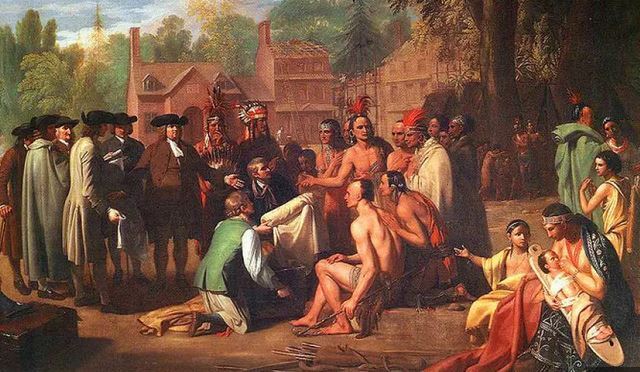
NEW JERSEY - The land comprising modern-day New Jersey, along with adjacent parts of New York, Pennsylvania, and Delaware, was historically and primarily the territory of a single, extensive Indigenous Nation known as the Lenape (or Lenni-Lenape), who are also called the Delaware People.
The name Lenni-Lenape translates to "Original People" or "Real People," reflecting their historical position as the "Grandfathers" among the greater Algonquian language family of the Northeast. The Lenape were not a single unified tribe but a loose confederation of independent communities sharing a common ancestry and language, which they called Lenapehoking (Lenape Land).
The Lenape and Their Divisions (Lenapehoking)
The Lenape Nation was divided geographically and linguistically into three main dialectal groups at the time of European contact.
The Munsee (Minsi) occupied Northern New Jersey, specifically the Highlands region, covering the Upper Delaware River Valley and the Appalachian Ridge-and-Valley area, speaking a Northern (Upland) dialect. The Unami were situated in Central New Jersey, encompassing the Piedmont region, including areas like the Raritan and central Delaware River Valleys, and spoke a Central (Downriver) dialect. Finally, the Unalachtigo inhabited Southern New Jersey, spanning the Coastal Plain, including the lower Delaware River, the Atlantic coast, and parts of southern New Jersey, and spoke a Southern (Near the Ocean) dialect.
Culture and Subsistence
The Lenape were highly skilled at adapting their lifestyle to the seasonal changes and resources of their environment:
-
Matrilineal Society: They had a matrilineal clan system, meaning descent and social status were traced through the mother, and children belonged to their mother's clan. They also historically practiced matrilocal residence, in which husbands moved to live with their wife's family.
-
Settlements: They lived in villages of longhouses (yehakins) and were semi-sedentary, moving seasonally to take advantage of resources.
-
"Three Sisters" Agriculture: Their diet was based on the "Three Sisters" (maize, beans, and squash), which the women cultivated. Men were responsible for hunting, fishing, and harvesting seafood (especially from the coastal areas).
-
Wampum: They were major producers of wampum (shell beads), which was used for ritual purposes, ornamentation, and as a medium of exchange, particularly in the fur trade with European newcomers.
The Legacy and Modern Tribes
Like other Indigenous Nations, the Lenape faced significant disruption from European diseases, warfare, and land dispossession, which began with the Dutch and Swedish colonists and continued under the English. By the 18th century, most Lenape had been forced to move westward, settling in places like Ohio, Indiana, and eventually Oklahoma, Wisconsin, and Canada, where several federally recognized Lenape/Delaware tribes exist today.
Despite this forced dispersal, many Lenape people remained in their ancestral lands. Today, New Jersey officially recognizes several Indigenous communities with deep roots in the state, including the Nanticoke Lenni-Lenape Tribal Nation, the Ramapough Lenape Nation (also known as the Ramapough Mountain Indians), and the Powhatan Renape Nation.
 These nations continue to preserve their cultural heritage and maintain their presence in New Jersey, carrying forward the legacy of the Original People.