VIRGINIA - The land that became Virginia, particularly the fertile Tidewater region and the vast expanses stretching to the Appalachian Mountains, was home to a rich tapestry of Indigenous Nations for thousands of years. At the time of sustained European contact in the early 17th century, these peoples represented three prominent language families: Algonquian, Siouan, and Iroquoian. Their cultures were deeply intertwined with the landscape, thriving on the resources of the Chesapeake Bay, its numerous rivers, and the dense forests.
The Major Tribal Nations and Language Families
Virginia's Indigenous history is often understood through the lens of its linguistic and geographical divisions.
1. Algonquian-Speaking Tribes (Tidewater and Coastal Plain)
These nations occupied the low-lying coastal plain and were the primary groups encountered by the English colonists at Jamestown.
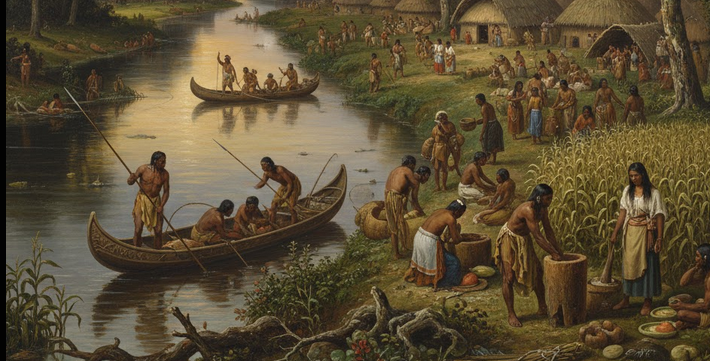
The Powhatan Confederacy: the most potent and well-known group. Led by Chief Powhatan (father of Pocahontas), this confederacy comprised over 30 smaller tribes or chiefdoms (like the Pamunkey, Mattaponi, Chickahominy, Arrohateck, and Chesapeake) who lived along the major rivers flowing into the Chesapeake Bay.
Culture: They were skilled agriculturalists, cultivating corn, beans, and squash, supplemented by intensive fishing, hunting, and gathering. They lived in villages of longhouses (or yehakins) and were politically sophisticated.
Historical Significance: Their interactions with the Jamestown settlers (including the famous story of Pocahontas) shaped the early history of English colonization in North America.
2. Siouan-Speaking Tribes (Piedmont and Ridge-and-Valley Region)
West of the fall line, in the Piedmont and Blue Ridge Mountain foothills, lived nations speaking Siouan languages.
- Monacan: A significant Siouan-speaking nation whose territory stretched across central Virginia, including the headwaters of the James and Rappahannock Rivers. They were known for their rich ceremonial life and extensive earthwork mounds.
- Saponi, Tutelo, Occaneechi: Other Siouan-speaking groups who lived in south-central Virginia and maintained complex trade networks.
3. Iroquoian-Speaking Tribes (Southern Virginia)
In the southernmost parts of Virginia, bordering what is now North Carolina, were communities speaking Iroquoian languages, related to the powerful Iroquois Confederacy to the north.
- Nottoway: This Iroquoian-speaking tribe lived along the Nottoway River in southeastern Virginia. They maintained distinct cultural traditions and engaged in trade with both Algonquian and Siouan neighbors.
- Meherrin: Another Iroquoian group located along the Meherrin River, closely related to the Nottoway.
Key Cultural Features and Subsistence
Resourcefulness: All groups were expert at utilizing their local environments. Algonquians excelled at aquatic resource management, Siouans were adept at hunting and cultivating upland areas, and Iroquoians managed their riverine territories.
Political Systems: While the Powhatan Confederacy was a prominent example of a unified political entity, other groups operated as independent villages or smaller confederations, adapting their governance to their specific needs and territories.
The Enduring Legacy and Modern Recognition
- The arrival of English colonists brought devastating diseases, land loss, and warfare that profoundly impacted Virginia's Indigenous populations. The Powhatan Confederacy, after fierce conflicts, was eventually fragmented, and many tribes were forcibly displaced or saw their numbers dwindle drastically.
- Despite this history, Native American people have maintained their cultural identities and continued to thrive in Virginia. Today, the Commonwealth of Virginia officially recognizes eleven tribal nations, and seven of these have also achieved federal recognition:
Federally Recognized Tribes:
- Pamunkey Indian Tribe
- Mattaponi Tribe
- Chickahominy Indian Tribe
- Eastern Chickahominy Indian Tribe
- Upper Mattaponi Tribe
- Monacan Indian Nation
- Nansemond Indian Tribe
State-Recognized Tribes:
- Catawba Indian Nation (also federally recognized in South Carolina)
- Nottoway Indian Tribe
- Cheroenhaka (Nottoway) Indian Tribe
Patawomeck Tribe
These sovereign nations are vital contributors to Virginia's cultural landscape, actively preserving their languages, traditions, and ancestral lands.
Who Where The Native Peoples of Virginia?
Who Where The Native Peoples of Virginia?
Typography
- Smaller Small Medium Big Bigger
- Default Helvetica Segoe Georgia Times
- Reading Mode