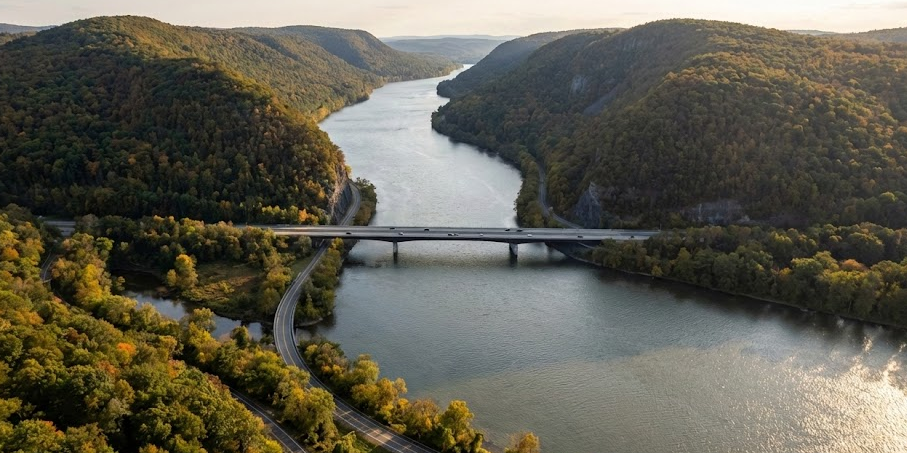
PENNSYLVANIA - If you look at a topographical map of Pennsylvania, you’ll notice something that shouldn't make sense. The Appalachian Mountains run in long, parallel ridges from northeast to southwest. By the laws of physics, water should flow around these massive stone walls, finding the path of least resistance. But the Susquehanna River doesn’t do that. It flows almost directly north-to-south, slicing straight through the mountain ridges as if they aren't even there.
It behaves this way for one mind-bending reason: The river was here first.
The "Antecedent" Anomaly
Geologists call the Susquehanna an "antecedent river." This means it established its course before the topography around it was formed.
Most rivers are "consequent," meaning they form after the landscape, flowing into valleys and around hills that already exist. The Susquehanna is different. It was already flowing toward the ocean hundreds of millions of years ago, back when Pennsylvania was a flat coastal plain.
Around 300 million years ago, during the Alleghanian Orogeny (the mountain-building event that formed the Appalachians), the African and North American tectonic plates collided. This collision pushed the earth upward, crumpling the land into the ridges we see today.
As the land slowly rose up beneath the river, the Susquehanna didn't change course. Instead, it used the power of its current to erode the rock downward at the same speed the mountains were being pushed upward. It acted like a geological saw, cutting "water gaps" through the stone ridges as they emerged.
Older Than the Nile (And the Atlantic)
It is difficult to overstate just how old this river is.
- The Nile River is estimated to be about 30 million years old.
- The Colorado River (which carved the Grand Canyon) is roughly 6 to 70 million years old.
- The Susquehanna River is estimated to be over 300 million years old.
This means the Susquehanna was flowing before the Atlantic Ocean opened up. It was flowing before the first dinosaur walked the earth. It is a remnant of the Paleozoic Era, making it widely considered the oldest major river system in the Eastern United States and one of the five oldest rivers in the world.
The Visual Proof
You don't need a geology degree to see this ancient battle between water and rock; you just need to drive north of Harrisburg.
The most famous evidence of this process is the Susquehanna Water Gap. As you drive along U.S. Routes 11/15 or 22/322, look at the mountains (Blue Mountain and Second Mountain). You will see the ridges abruptly end, drop down to the water, and then pick up again on the other side.
That gap wasn't formed by a sudden catastrophe. It is the result of a slow-motion, 300-million-year stalemate where the water refused to give up its right of way.
Why It Matters
 In a world where landscapes are constantly changing, the Susquehanna is a rare constant. It has survived the collision of continents, the tearing apart of Pangea, and multiple Ice Ages.
The next time you cross a bridge over the Susquehanna, remember: You aren't just crossing a body of water. You are crossing a geological elder that watched the mountains rise, and will likely still be flowing long after they have worn back down to dust.