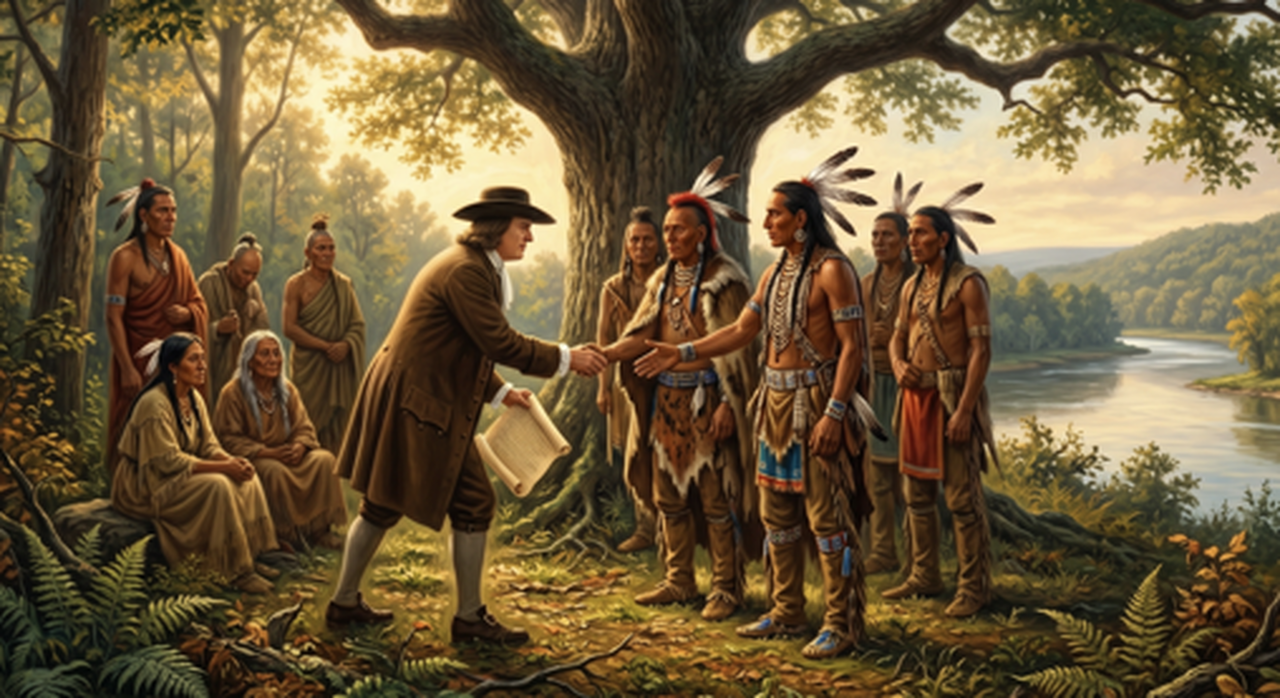
PENNSYLVANIA - When tracing the roots of American history, the Keystone State sits at the very center of the narrative. Pennsylvania is famous for being the birthplace of the Declaration of Independence and the United States Constitution. But long before it officially became the second state to ratify the Constitution in 1787, this vast, resource-rich territory underwent several dramatic transformations.
Tracing the origins of Pennsylvania's name reveals a lot about the early days of American colonization. But to get the full story, you must look back centuries before statehood was even on the table. Here is the authoritative history of what Pennsylvania was called before it became a state.
The Original Inhabitants: Lenapehoking
Long before European explorers arrived, various indigenous tribes—such as the Lenape (or Delaware) and the Susquehannock—made Pennsylvania their home. While there were no official European borders back then, the vast territory stretching across eastern Pennsylvania, New Jersey, eastern Delaware, and the lower Hudson Valley was well known as Lenapehoking, meaning "the homelands of the Lenape." These communities lived along the region's major river systems, deeply tied to the natural geography of the woodlands long before any royal charter was drawn up.
The First European Names: New Sweden and New Netherland
The first European claims to the territory did not come from the English, but rather from the Swedish and the Dutch.
In 1638, Swedish and Finnish settlers established a colony along the lower Delaware River. For nearly two decades, the southeastern slice of modern-day Pennsylvania, along with parts of Delaware and New Jersey, was officially known as New Sweden (or Nya Sverige). They established Fort Nya Gothenburg near present-day Philadelphia.
This name, however, was short-lived. In 1655, the neighboring Dutch forces, led by Peter Stuyvesant, moved in and conquered the Swedish settlements. The territory was quickly absorbed into the Dutch colonial empire and rebranded as part of New Netherland (Nieuw-Nederland). The Dutch controlled the region up until 1664, when the English arrived and took control of the entire region during the Second Anglo-Dutch War.
The Royal Charter: The Province of Pennsylvania
The name we recognize today was officially born on March 4, 1681. King Charles II of England owed a massive debt of £16,000 to the late Admiral Sir William Penn. To settle this debt, the King granted a massive tract of land in the New World to the Admiral's son, William Penn.
Penn, a devout Quaker, did not want the land named after himself, fearing it would appear vain. Due to the region's hilly terrain, he initially suggested the name "New Wales". Which was soon rejected, he proposed Sylvania, which is Latin for "woods" or "forest."
King Charles II, however, insisted on honoring the late Admiral. He officially announced that the territory would be named Pennsylvania—literally meaning "Penn's Woods." From 1681 up until the American Revolution, the region was officially recognized under British colonial rule as the Province of Pennsylvania (historically known as the Pennsylvania Colony).
The Transition to Statehood: The Commonwealth
When the American Revolution broke out, Pennsylvania dropped its royal charter. In 1776, it adopted its first constitution, officially changing its name to the Commonwealth of Pennsylvania.
Even today, Pennsylvania is legally a "Commonwealth" rather than a "State"—a distinction it shares with just three other states: Virginia, Massachusetts, and Kentucky. The title was chosen to show that the new government was built for the common "weal," or the well-being of the public, completely independent of the British crown.
Finally, on December 12, 1787, the Commonwealth of Pennsylvania ratified the United States Constitution, officially becoming the second state in the new American union.
Here is a quick look at how the region's name changed over the centuries: Before the 1600s, the land was known as Lenapehoking. From 1638 to 1655, it became the Swedish colony of New Sweden, which the Dutch then took over and renamed New Netherland until 1664. Under British rule from 1681 to 1776, it was officially called the Province of Pennsylvania, and it finally became the Commonwealth of Pennsylvania in 1776.