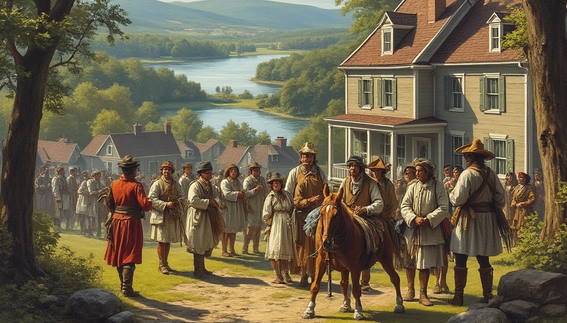
MARYLAND - Maryland is famous for its blue crabs, the vibrant Inner Harbor of Baltimore, and its status as the cradle of American religious freedom. Yet, long before it became the seventh state to ratify the U.S. Constitution on April 28, 1788, this region on the Chesapeake Bay was the scene of one of England's most fascinating and progressive colonial experiments.
The history of pre-statehood Maryland is not a simple story of pioneering expansion. It is a nuanced narrative of conflicting faiths, unique legal definitions, and geopolitical rivalries, all centered on the waters that define its geography.
The Chesapeake's First People: Tockwogh and Piscataway
When the first European ships sailed up the bay, they were not entering an empty wilderness. The region we now call Maryland had been inhabited for millennia. Archaeologists date human presence in the area back roughly 10,000 years, to the Paleo-Indian period.
By the early 17th century, the region was home to complex Algonquian-speaking societies that had transitioned from hunting and gathering to a permanent, agrarian life, relying on the sophisticated cultivation of maize (corn), beans, and squash.
The Piscataway
The most prominent group in what is now southern Maryland (the future site of the first capital) was the Piscataway Chiefdom (Conoy). They were a powerful, hierarchical society, led by a supreme ruler known as the "Tayac," with a population estimated at several thousand. They carefully managed the land through seasonal burning, making the forests easier to navigate and creating better farmland and game areas.
Other Groups
Groups like the Tockwogh, Nanticoke, and Choptank populated the Eastern Shore. To the north, along the Susquehanna River, lived the Susquehannock—a fierce, Iroquoian-speaking group who frequently raided Algonquian lands and initially controlled much of the interior trade.
Initial contacts ranged from tentative trade to violent clashes, as recorded by Captain John Smith when he mapped the bay. Disease introduced by Europeans, however, would do far more to decimate these native populations than any early warfare.
The Virginia Encroachment: Kent Island and Claiborne
The territory of Maryland was originally included in the 1609 charter of the Virginia Colony. Therefore, the first English settlement in present-day Maryland was actually a Virginia settlement.
In 1631, William Claiborne, a prominent Virginia surveyor and merchant, established a fortified trading post on Kent Island in the middle of the Chesapeake Bay. He negotiated directly with the Susquehannock and was running a prosperous fur trade operation.
Claiborne, a staunch Protestant, viewed Kent Island as integral to Virginia. He would spend the rest of his life as Maryland's chief antagonist, battling to regain control after the land was granted to a new proprietor.
The "Holy Experiment": The Calverts' Dream
Maryland is the only state named to honor a Roman Catholic Queen. George Calvert, the first Lord Baltimore, was a prominent minister to King James I, but he sacrificed his political career by converting to Catholicism. In 1625, this conversion forced him to resign as Secretary of State.
Seeking a haven where Catholics could escape persecution in England, Calvert petitioned the King for a charter in the New World. He initially received a charter for Avalon in Newfoundland (near modern Canada). Still, after visiting and experiencing the brutal climate, he abandoned it, famously describing the land as "nothing but a mass of ice and snow."
Calvert then lobbied for a charter for a warmer region south of New England. He died just before the charter was finalized in June 1632, so it was issued to his son, Cecilius Calvert, the second Lord Baltimore.
A Palatinate Province
The charter was extraordinary. King Charles I granted the 35 million acres not merely as a simple colonial grant, but as a "Palatinate," meaning Lord Baltimore owned Maryland outright and was granted nearly king-like authority, including the power to raise a private army, coin his own money, and establish his own courts. He only had to yield a small formal tribute to the King: "two Native Arrows...delivered at our Castle of Windsor, on the Tuesday in Easter Week, every year."
The Potomac River bounded the territory to the south, the 40th parallel (later redefined by the Mason-Dixon Line) to the north, and extended from the Atlantic coast to the sources of the Potomac. Cecilius named his new domain Terra Mariae (Maryland) in honor of Queen Henrietta Maria, the Catholic wife of King Charles I.
Founding and Fracture (1634–1689)
The First Capital
On November 22, 1633, a pair of small ships, the Ark and the Dove, set sail from England carrying approximately 140 passengers, including a handful of Jesuit priests. They arrived in the Chesapeake Bay in March 1634.
Led by Lord Baltimore's younger brother, Leonard Calvert, they landed at the southern tip of Maryland's western shore. They negotiated a safe arrival with the leader of the local Yaocomico and purchased the land for their first capital. They named it St. Mary's City. St. Mary's remains the fourth-oldest permanent English settlement in the United States and the oldest planned English city in North America.
The Problem of Toleration
This was the core of Lord Baltimore's experiment: Maryland was the first English colony established specifically to allow freedom of worship. While Cecilius had envisioned a Catholic sanctuary, the majority of the settlers who arrived were Protestant.
The first decades were precarious. William Claiborne, still on Kent Island, rejected Maryland's authority. This dispute led to North America's first naval battle in 1635, a brief, chaotic conflict that the Maryland forces won. Claiborne was arrested but continued his legal and political assault for decades.
Plundering Time
Tensions exploded again when England plunged into its own Civil War (1642–1651). The religious and political fractures of the motherland were mirrored in Maryland. In 1644, Richard Ingle, a Protestant merchant and ship captain, captured St. Mary's City. Governor Leonard Calvert was forced to flee to Virginia. Ingle and his forces spent the next two years pillaging the colony, a period Marylanders remembered as the "Plundering Time." Jesuit priests were shackled, houses burned, and the colony almost collapsed. Leonard Calvert eventually raised an army in Virginia and, in 1646, retook St. Mary's City.
The Toleration Act of 1649
Following Leonard Calvert's death in 1647, Lord Baltimore realized that to save his colony from growing Protestant opposition, he had to enshrine his pluralistic philosophy into law. In 1649, the Maryland Toleration Act (officially the "Act Concerning Religion") was passed by the colonial assembly. It was the first law in American history to guarantee religious freedom for all who "professed to believe in Jesus Christ." This included both Catholics and all forms of Protestants, though it pointedly did not extend to Jews, Atheists, or non-Trinitarians. It remained law for nearly forty years and served as a crucial precursor to the religious protections in the Bill of Rights.
The Conflict Continues
The Toleration Act was short-lived. In 1650, English Puritans under Oliver Cromwell established a settlement in Maryland at Providence (later renamed Annapolis). As the Civil War in England drew to a close, this new, powerful group took control of the assembly, banned the Catholic faith, and repealed the Toleration Act in 1654. This led to a dramatic conflict, the Battle of the Severn (March 1655), in which Protestant forces defeated Maryland's Catholic governor and executed several Catholic and Quaker loyalists. Lord Baltimore's proprietary power was restored by the English crown only four years later, after Cromwell's fall.
The Royal Transition and the Rise of a New Maryland (1689–1776)
In 1689, a "Glorious Revolution" in England ousted the Catholic King James II and replaced him with the Protestant joint monarchs, William and Mary. This meant the end of Lord Baltimore's dream. In the "Protestant Revolution" of 1689, Protestant forces, led by John Coode, seized St. Mary's City, demanding that the Calverts be removed from power.
Royal Government
King William III heard their petitions and, in 1691, officially removed the Calverts' right to govern Maryland. It became a Royal Colony, meaning the King, not Lord Baltimore, appointed the governor and oversaw its operations. The Calvert family, however, still retained proprietary ownership of the land (and its income). One of the first acts of the new royal government was to formally establish the Church of England as the official colonial Church, funded by new taxes, and to ban once again Catholic worship in public, including barring Catholics from holding any political office.
The Move to Annapolis
In 1694, the royal government made another symbolic change. Seeking a more central, Protestant-aligned location, they moved the capital from Catholic-founded St. Mary's City to Annapolis (then known as Anne Arundel Town). Annapolis, with its planned circular street grid and baroque architecture, would soon surpass Philadelphia as the cultural and political capital of the Chesapeake region.
Reversion to Proprietary Rule
In 1715, Benedict Leonard Calvert, the fifth Lord Baltimore, a great-grandson of the first, renounced his Catholic faith and formally converted to the Church of England. This strategic move worked. Having removed the religious objection, King George I restored the Calverts' full palatinate powers. Maryland reverted to being a proprietary colony and would remain one until the American Revolution.
Maryland in Revolution (1774–1788)
In the decades leading to 1776, Maryland found common cause with other colonies. It grew increasingly resentful of British economic restrictions (like the Stamp Act of 1765). As tensions escalated, Maryland leaders met in various bodies, like the "Annapolis Convention." Maryland was a vital center of shipbuilding and grain production, both essential for the eventual war effort.
In 1774, when the Continental Congress met in Philadelphia, Maryland sent a dynamic delegation. On July 4, 1776, this group, including Charles Carroll of Carrollton (the only Catholic to sign), signed the Declaration of Independence.
Following Britain's final surrender, Marylanders again led the charge to reform the Articles of Confederation. The Constitutional Convention met in Philadelphia in 1787, where Maryland delegates played a critical role in structuring the government. Finally, on April 28, 1788, the Commonwealth of Maryland ratified the new Constitution, officially transitioning from its fascinating pre-statehood palatinate into the seventh state of the new American union.