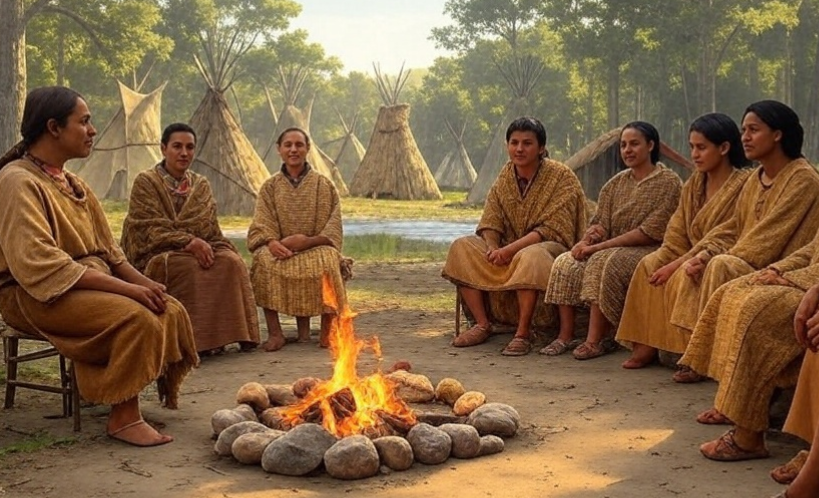
SOUTH CAROLINA - South Carolina has a rich and complex Indigenous history, with an estimated twenty-nine different Native American nations inhabiting the land for thousands of years before European contact. These groups came from diverse cultural and linguistic backgrounds, primarily clustered into five major language families: Siouan, Iroquoian, Muskogean, Algonquian, and Yuchi/Uchean.
 Before the arrival of Europeans, these peoples survived mainly through hunting, fishing, and farming. Sadly, the Indigenous population in South Carolina and across the United States declined drastically after the arrival of Europeans. Tribes were weakened by European diseases, such as smallpox, for which they had no immunity, and by conflicts with settlers over trade practices and land. By the early 1700s, tribal populations had faced devastating decline, leading smaller groups to consolidate into four major nations that played a key role in the colonial period: the Cherokee, Creek, Cusabo, and Catawba.
Prominent Native American Nations of South Carolina
The following nations represent the most prominent groups whose histories are deeply intertwined with the land of modern South Carolina:
-
Catawba (also known as the Esaw): This nation traditionally inhabited the Piedmont region along the Catawba River and are Siouan speakers. They were once considered one of the most powerful tribes in the Southeast. The Catawba lived in villages surrounded by palisades, featuring a council house, sweat lodge, and rounded bark homes. They were historically sedentary agriculturists, growing corn and squash, and are noted for their ancient tradition of pottery. The Catawba Indian Nation is the only federally recognized tribe in South Carolina today, with their reservation near Rock Hill in York County. They call themselves yeh is-WAH h'reh, meaning “people of the river.”
-
Cherokee: The Cherokee, who are Iroquoian speakers, were the largest single Native American nation in the South, primarily inhabiting the Southern Appalachian Mountains in the Upstate/Western region of South Carolina. They called themselves “Ani Yunwiya,” or the “Principal People.” The Cherokee first encountered Europeans with the De Soto expedition in 1540. Their villages in South Carolina included Lower Settlements like Old Estatoee, Keowee, and Oconee. Due to conflicts and the devastating effects of disease, the Cherokee were forced to cede large portions of their land, culminating in the forced removal of thousands during the Trail of Tears in 1838.
-
Cusabo: This was a collective designation for a loose alliance of coastal tribes, including the Edisto, Sewee, Kusso, and Etiwan peoples, inhabiting the Coastal Lowcountry between present-day Charleston and Savannah. Their language is generally thought to be Siouan or Muskogean, though possibly Arawakan. They were among the first to encounter European explorers.
-
Pee Dee: This collection of Siouan-speaking communities lived in the Pee Dee River Valley in Northeastern South Carolina. Descendants of the Pee Dee are represented by several modern state-recognized tribes.
-
Yamassee: Primarily a Muskogean-speaking group, the Yamassee moved into South Carolina from Spanish Florida and occupied the southern coastal areas. They are historically famous for leading the Yemassee War (1715–1716) against the South Carolina colonists, a major eighteenth-century conflict.
Modern Recognition in South Carolina
Today, the Indigenous presence in South Carolina is recognized through both federal and state governments:
-
Federally Recognized Tribe: The Catawba Indian Nation is the only federally recognized tribe in the state, having successfully regained federal recognition in 1993 following a land claim settlement.
-
State-Recognized Tribes and Groups: South Carolina also officially recognizes several other Native American entities, including the Beaver Creek Indians, Edisto Natchez-Kusso Indians, Pee Dee Nation of Upper South Carolina, Pee Dee Indian Tribe of South Carolina, Waccamaw Indian People, Wassamasaw Tribe of Varnertown Indians, Santee Indian Organization, Sumter Tribe of Cheraw Indians, Lower Eastern Cherokee Nation of South Carolina, and Chaloklowa Chickasaw Indian People.
These modern nations continue to preserve and revitalize their cultural heritage, language, and sovereignty within the state.