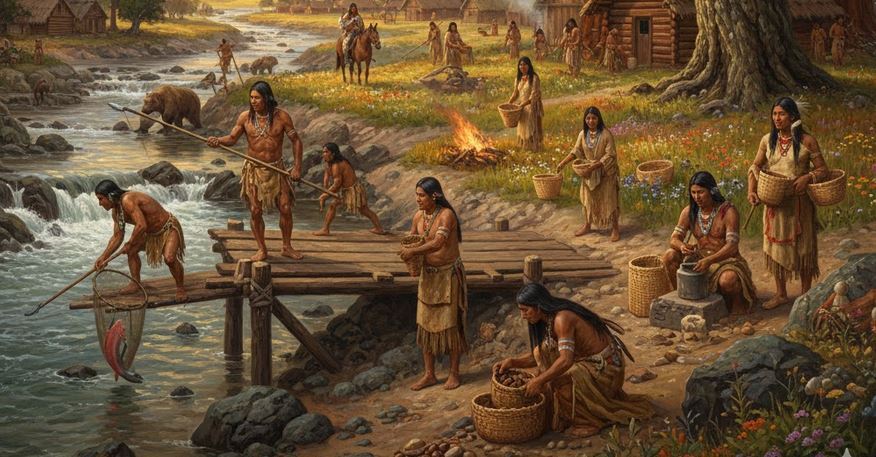
MARYLAND - The territory now known as Maryland, particularly the vast waterways of the Chesapeake Bay, has been home to diverse Indigenous communities for over 10,000 years. At the time of European contact in the early 17th century, the landscape was primarily populated by peoples of the Algonquian language family, with distinct groups occupying the Western Shore, the Eastern Shore, and the mountainous areas to the west.
The Indigenous Peoples of Maryland: Stewards of the Chesapeake
The Native Nations of this region were adept at utilizing the resources of the Bay and its tributaries, leading lives centered on fishing, hunting, and agriculture.
Major Tribal Nations and Cultural Groups
The pre-contact Indigenous population of Maryland can be broadly categorized into two major linguistic groups:
1. Algonquian-Speaking Tribes (Chesapeake Bay Region)
The majority of tribes encountered by early European explorers, such as Captain John Smith, spoke Algonquian languages. Their cultures were strongly tied to the water.
- Piscataway (Conoy): This was a paramount chiefdom or "nation" on the Western Shore, particularly along the Potomac River. They were politically dominant in the area that now includes Southern Maryland and Washington, D.C., with smaller bands paying them allegiance. They are a prominent state-recognized tribe today.
- Nanticoke: Located primarily on the Eastern Shore along the Nanticoke River and the Delmarva Peninsula. They were known to be skilled traders and maintained complex ceremonial and religious practices.
- Choptank: Another important Algonquian group on the Eastern Shore (modern-day Dorchester, Talbot, and Caroline Counties). They were the only Indigenous group granted a reservation by the Maryland colonial government, though the land was later sold in 1822.
- Assateague, Pocomoke, and Accohannock: Tribes that lived along the lower Eastern Shore, adapting to coastal environments and marshlands.
2. Iroquoian and Siouan Influences
Groups speaking Iroquoian and Siouan languages also maintained a significant presence, especially in the north and west.
- Susquehannock (Iroquoian): A powerful Iroquoian-speaking tribe that controlled trade along the Susquehanna River, extending their influence down into the northern areas of Maryland. They were often in conflict with the Algonquian tribes of the Chesapeake.
- Lenape (Delaware): Bands of the Lenape, also Algonquian speakers, lived in the northeast, particularly around Cecil County.
Key Cultural Features
- Subsistence: These nations practiced a mixed economy. They cultivated crops like corn, beans, and squash in villages but relied heavily on the Bay's natural bounty—fishing, oystering, and hunting (especially deer, elk, and bear) were vital.
- Political Structure: Many Algonquian groups were organized into chiefdoms or confederacies, with a central chief or werowance governing several towns or bands. The Piscataway Chiefdom is a primary example.
- Trade Routes: The Chesapeake Bay and its rivers served as essential trade networks. Groups like the Susquehannock acted as middlemen, connecting the coastal tribes with inland Iroquoian groups.
The Enduring Presence and Modern Recognition
 European colonization brought devastating diseases, displacement, and conflicts, severely reducing Maryland's Native population. By the early 1700s, most remaining groups were forced to migrate north, west, or assimilate into colonial society.
However, many descendants remained, maintaining their cultural identities, often quietly, in their ancestral homelands.
-
State Recognition: The State of Maryland has officially recognized several tribes:
- Piscataway-Conoy Tribe
- Piscataway Indian Nation
- Accohannock Indian Tribe
Modern Community: While there are currently no federally recognized tribes in Maryland, the state is home to a large and vibrant Indigenous population. This includes descendants of the original nations, as well as a significant presence of members from other tribes, such as the Lumbee Tribe of North Carolina, who form a large urban Native community in Baltimore.